
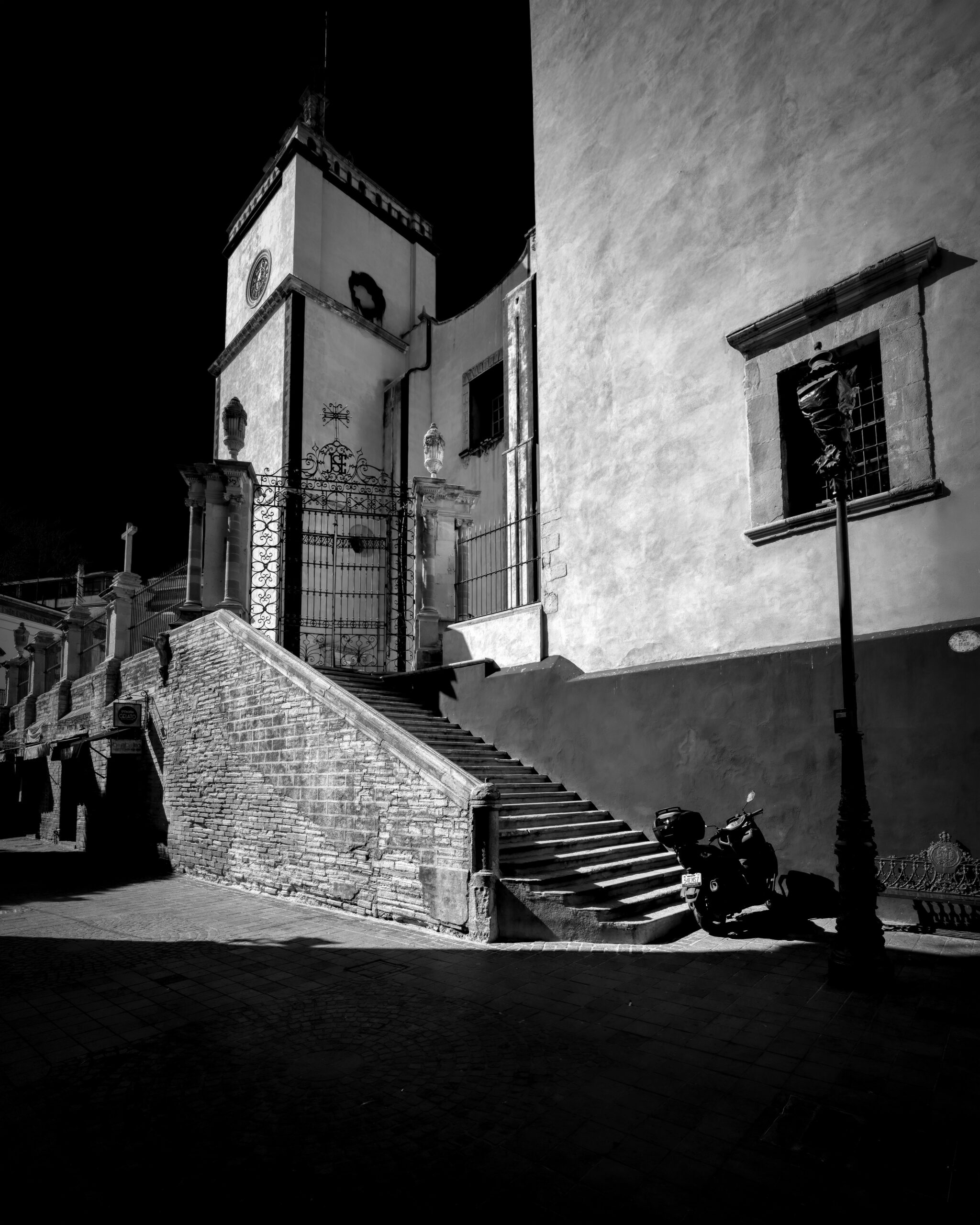
Every so often a scene hands you a photograph before you’ve even lifted the camera. I think of a staircase I photographed in southern Europe not long ago: worn stone steps climbing toward the iron gate of a Baroque church, half the frame swallowed by shadow so dark it reads as pure black, the sunstruck bell tower rising clean and white against it. A scooter parked at the foot of the stairs. A single street lamp holding its own thin line of light. Nothing else. The photograph is really just two shapes — light and dark — fighting for the same square meter of frame.
That’s chiaroscuro (or claroscuro), an Italian word literally meaning “light-dark,” borrowed from Caravaggio and the Baroque painters who used it to make ordinary rooms feel like theater. In photography it means the same thing it meant on canvas four hundred years ago: you stop trying to even out the exposure and instead let the contrast do the storytelling. Shadows go to true black. Highlights are allowed to blaze. The eye does the rest, because human vision is wired to read edges of contrast before anything else in a frame.
A few things I keep in mind when I’m chasing this look:
- Hard light is the friend, not the enemy. Everyone chases the soft, forgiving light of early morning and late afternoon. Chiaroscuro wants the opposite — the harsh, high-angle sun of midday, the kind that carves deep shadow under an archway or beneath a staircase. If the light is flat, the technique doesn’t work.
- Expose for the highlights, let the shadows fall where they want. Meter for the brightest part of the scene — the sunlit wall, the white stone — and accept that everything else will go dark. Trying to “save” shadow detail is usually what kills the effect.
- Black and white does half the work for you. Strip out color and you’re left with pure value contrast, which is really the whole point of the technique. It’s no accident that most of the strongest chiaroscuro photographs, mine included, end up converted to monochrome.
- Leave one small anchor in the shadow. In that staircase photo, it’s the parked scooter — a small, mundane, human detail sitting inside all that blackness. Without it, the shadow reads as empty. With it, it reads as a place.
It’s a demanding style — it asks you to throw away information rather than capture it — but when it lands, nothing else looks quite as dramatic.